 I would like to start this post (which will ultimately be a review of Adjustment Bureau) with a small confession. Even before I started this blog almost four years ago, my dream was to find work in Hollywood as a Dickian dramaturge, a PKD expert who helps movie producers keep their adaptations of his work true to the source material. It's a fairly common job among scholars of Shakespeare.
It was 2007 - a heady time. I was still riding high on the release of A Scanner Darkly (which my buddy Erik Davis consulted on) and as I started my job as an English teacher with my newly acquired Master's Degree, the idea of flying off to Cannes and hobnobbing with Brad Pitt as I explained the importance off looking defeated when he played the role of Jason Taverner was a nice fantasy. Admittedly, this was more than a bit naive, but, if we're being honest here, it was a dream I was trying to achieve with this blog.
And it was a dream that died about 18 minutes into The Adjustment Bureau on Friday night. The death of my dream was no surprise, as it had been on life support for a long time. And it wasn't a bummer or anything. I simply realized the dream job of keeping big-money PKD adaptations faithful to his source material is like warm ice or dry water, an oxymoronic impossibility. So, don't be sad. As Kris Kristofferson once wrote, "Freedom's just another word for nothing left to lose" and now I'm free.
First things first. The Adjustment Bureau is not a PKD adaptation. As I noted before, the central premise of a secret organization dedicated to keeping mankind on a preferred timeline is at the crux of Isaac Asimov's Foundation Series, which were pretty much the first SF books I ever read. After reading PKD's short story (which as previously noted appeared a year or so after the first book in the Foundation series) I feel like PKD lifted the concept from Asimov and employed it brilliantly to create on of his greatest 'gubble' moments, when reality appears to dissolve before a character's very eyes - they suffer the symptoms of schizophrenia, the withdrawal and subsequent 'tomb world' imagery, while in full control of their mental faculties.
As was done in Next, Dick's original short story was strip-mined for its science fictional idea and then discarded. Producers took that nice little idea and transplanted it into a feature length film, but the end result is about as Dickian as a spring wedding (a prize will be awarded if anybody can find me a marriage scene in Dick's irv). The fact is, no big-money Hollywood adaptation can ever be truly faithful to the source material, mostly because Hollywood is a place where illusions are constructed, a place that is itself an illusion, a place that frankly wouldn't know 'reality' if it were to bite it in the ass -a place so hopelessly dedicated to creating high-priced and profit-driven fantasies that it has no ability to tell us what is real. Hollywood, by its very makeup, is too inauthentic to capture the great humanism that marks authenticity in Dick's books.
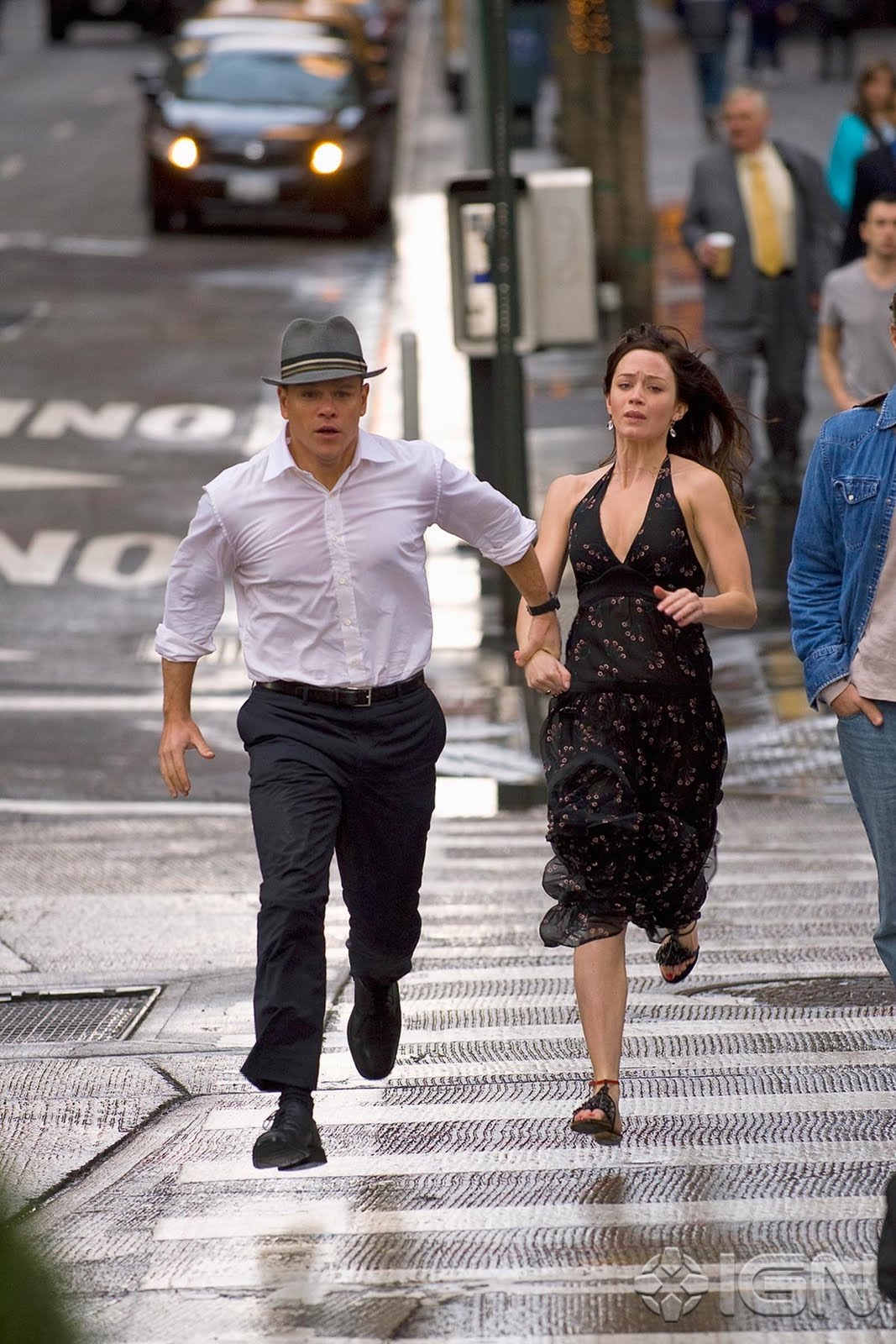
Matt Damon's character, David Norris, is running for a senate seat when we first meet him. In Dick's story Ed Fletcher is a real estate agent. The protagonist's elevation in stature is important - at least to me. You see if he were just an everyday guy, then the story's paranoiac elements become more pronounced. Paranoia involves an exaggerated sense of self-importance. If they're all out to get you, it is logical to assume that you are very powerful and important. If the main character is already a famous, super-scientist or running for senate with presidential aspirations, then he's already self-important. To make Damon's character a big shot, is to tweak the fundamental formula at the core of Dick's work. His characters are always everyday people, put upon by the world. Any two paragraph summary of Dick's significance in Science Fiction should include his use of average Joes and Joans. So while I understand the change, the filmmakers should have been warned they were meddling with the forces of nature.
Oh man, this is getting too long. Nobody's gonna read it and if they do they'll think I'm ranting.
I kind of liked watching the movie and imagining the action was entirely internal to Norris' psyche. Regular reader, Mr Hand, who saw the film with me, thinks this is what Rickels means by endopsychic allegory, but who the hell knows what Rickels means. Anyway, I liked the idea that the bureau was Norris' super-ego and his love for whatshername was his id. Then you have this nice internal struggle. And actually, this interpretation is plausible for like three seconds near the end of the movie, but then they go in a different direction (I'm going to write up a separate post with spoilers to talk more specifically about the ending).
I liked my idea; that the story should have been entirely solipsistic, existing in Norris' mind. And here's where my really important realization arrived. My desire to work as a dramaturge was, at its heart, an artistic aspiration. I'm realizing I should be writing my own stuff, which I have been doing, a bit. It's one of the reasons my posts here are have tapered off. I need to do more of that. Not that I'd turn him down if Gondry offered me a gig advising on the upcoming Ubik adaptation. And this blog isn't going anywhere either. I'm even more dedicated to studying Dick's life and work as he's my biggest influence.
Before you go, here's some chart-based evidence supporting the assertion that no good PKD adaption will be liked and no well-liked adaptation will be good:


 ? After all, wasn’t Clarence the Angel a sort of a benevolent “adjustor”, a case worker assigned by the “boss” to nudge Jimmy Stewart back onto his Pre-Ordained Path? Although the “G” word is never mentioned in Nolfi’s film, it’s pretty clear that the “Chairman” represents You-Know-Who (although every time the Chairman was mentioned, I kept visualizing Ralph Richardson’s marvelously droll Supreme Being in Terry Gilliam’s
 )."


