 Well gentle readers, Life is happening again, and I am once more struggling to find the time to keep the blog updated. I finished We Can Build You and need to post some thoughts on that, but I wanted to write a bit this morning about John Simon's awesome adaptation of Radio Free Albemuth - as you know I saw a final cut of it recently. What you may not know is that you can now add the film to your Netflix queue. Not that the the movie's available now; it won't actually be out until after it gets some kind of theatrical release later this year, but adding the film to your Netflix queue lets potential distributors know there is interest and may help in finding a deal for theatrical release. So, obviously, add the film to your queue.
But I really wanted to talk about the movie in relation to the recent protests in Egypt. Readers of Radio Free Albemuth already know the novels deals with the autocratic and oppressive regime of Ferris F Fremont (renamed Richard Fremont in the film). When the Egyptian government started rounding up journalists last week, in my mind I kept going back to the movie, which does an amazing job of capturing the maddening injustice of a government working against its people. I think it's Rickman (correct me in the comments section if I'm wrong) who talked about seeing wounds on PKD's arms, and that PKD had told him he'd cut himself with a crushed soda can after learning of Anwar Sadat's assassination - of course Sadat was Mubarak's predecessor so this is not so totally removed from the Dickian Universe.
 What I'm trying to get at is that Dick felt - in a physical sense - the injustice of the world; it abraded him, and saddened him in a way that's easy to underestimate given our own all-too-common detachment. At its best, Radio Free Albemuth evokes this physical, gut reaction to the ease and efficiency with which oppressive bureaucracies make the immoral moral, simply by substituting the inhuman needs of The State above the needs of the people. A day after some of the worst violence in Cairo, the government called the attacks on innocent protesters a mistake. They promised they would look into it. I got the same feeling in the pit of my stomach as I did at the climax of John Simon's cinematic adaptation.
One of the reasons the film evokes this feeling is the painstaking work Simon undertakes in building up Nick and Phil as characters. There's a scene in the movie where the two friends are shooting hoops in the gym. At first it struck me as an utterly un-Dickian scene. I can't, off the top of my head, think of any sports-related scene in PKD's irv (except of course isn't there a Dodger game near the end of Radio Free Albemuth, the novel?). As un-PKD as this scene first appears, it actually works, because it helps round out the characters. And this is a movie about characters. This is a movie about what happens to a friendship when one friend starts talking about crazy experiences. What happens to a marriage when one partner becomes convinced he's in communication with extra-terrestrials? How do loyalty and compassion work when it looks as if your friend has become un-moored from reality? These are important questions, and our answers to them tell us something about our own nature.
While VALIS is touted as the better novel - RFA is often just seen as a rough-draft of VALIS - RFA succeeds in focusing on the human elements of Dick's 2-3-74 experiences. While the human elements in VALIS are sometimes subsumed by the endless ontological riffing, Simon is able to forefront the human drama in RFA by building the narrative around Nick and Phil's friendship. As a result, the plot develops out of the characters rather than a science-fictional idea. This is one of the most interesting things that separates RFA from other adaptations of PKD's work: while Hollywood most often simply lifts one of PKD's SF concepts and grafts it into Keanu-Cruise computer-generated green-screen action flick with car chases, RFA eschews all of that in favor of the rich interpersonal drama of this friendship.
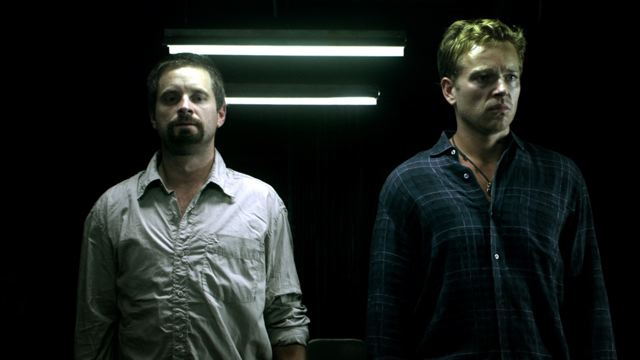 Amid all the high-stakes drama of the Egyptian protests and their foreign policy ramifications, it's easy to forget that what you are seeing on TV is a human drama, that the protests are made up not of demands but of people who want justice. Those aren't actors on your screen, and it isn't fake blood. It's an important thing to remember and Simon's adaptation of RFA in both form and content reminds us that this overarching concern with the human element in any situation is often at the core of Dick's fiction. I'm excited that one way or another, Dick-heads are going to get a chance to see this movie.


