Showing posts sorted by relevance for query erik davis. Sort by date Show all posts

Sunday, February 24, 2008

Erik Davis on PKD


Erik Davis, author of Techgnosis, recently reposted "Technomancer," an article he wrote on PKD for the Village Voice in 1989 (when I was ditching class and smoking pot my senior year in high school, still tragically unaware of Philip K Dick's existence). In fact Vintage culled the now-ubikuitous blurb: "Dick was many authors: a poor man's Pynchon, an oracular postmodern, a rich prophet of the changing counterculture" from this very article.

What I'm struck by is the amount of insight and detail in Davis' write up. His column makes every single article in the recent spate of PKD coverage look a like pre-fab, cut and paste job containing only the most superficial of details. Davis shows what's possible when you let someone who knows Dick's irv and who cares about Dick's ideas write about his literary accomplishments.

Davis writes:

"As far back as the ‘50s, Dick saw the dark, paranoid side of McLuhan’s global village. The animism that primitive humankind projected onto Nature was for him reborn in our technological environment, where ominous spiritual forces merged with the instruments of late capitalism. Dick’s machines are black jokes rather than believable imaginings..."

If Gopnik's article in The New Yorker had included even a single sentence with this kind of insight, this level of engagement with Philip K Dick and his ideas, perhaps we might have forgiven him for dragging PKD through the mud a bit. Philip K Dick was passionate about ideas, passionate about his writing, and desperate for readers willing to invest in his speculations and assume the mortality he depicted in his characters. Gopnik, et al, were satisfied with mere summary of Dick's life and work, but something more is needed if you really want to sell people on the worth of PKD's fiction; you need to plumb the depths a bit, come back from the novels with something to show for your effort if you expect others to make the journey.

Davis writes:

"Dick was a narrative trickster, a master mindfucker. He pulled the whodunit inside out: Decoding small meaningful details doesn’t put the picture together so much as rip it apart. By twisting the page-turning groove of pulp into a Möbius strip, Dick attempted to undermine the political, social, technological, and psychic structures of “reality.” He wanted a pulp guerilla ontology that deconstructed everyone’s power trip—Nixon’s, IBM’s, God’s, the author’s."

It's clear to me that many of those pre-fab PKD articles used Davis' write up as a kind of template, a set of talking points they would address in their own articles, but for Davis, PKD isn't merely a notable personality, his books serve as a searchlight for Davis' own explorations of reality or the lack thereof. This crucial difference drives home the power of the Internet, where we can find passionate guides for all of our own searches, rather than the paid, staid, and marketed efforts of "professionals" who cover our obsessions with token interest, and who are, ultimately, mere spectators here.

Read the rest of Davis' article. I promise, you won't be disappointed. The really exciting news is that Erik Davis is currently hard at work on a book-length examination of Dick's life and fiction. Both Jonathan Lethem and I feel that Erik is uniquely positioned to write one of the most important books about PKD ever, and after you read the rest of the article I think you'll agree.

Wednesday, January 24, 2024

Erik Davis on The Three Stigmata of Palmer Eldritch

Last night I traveled up to the old Berkeley flats, near the old stomping grounds of PKD, to hear Erik Davis give his first of five lectures on The Three Stigmata of Palmer Eldritch. Unfortunately, Erik's series is also on Tuesday evenings, when, after this week, I will be offering my own PKD class via Zoom. 

Davis was great, and it was awesome to see a roomful of people eager to engage with Phil Dick's weirdness. Interestingly a significant portion of the audience (maybe a third) had never read a PKD book before, which is a testament to their belief in Dr Davis' schtick. 

In the first lecture, Davis provided some background: how he got into Phil Dick (Berkeley druggies), how he was an early champion of PKD, most notably with his Village Voice article (which ended up getting blurbed on the Vintage editions calling Dick "A poor man's Pynchon,") and how he ended up working on The Exegesis.

Davis' overarching focus involves asking readers to play with the idea of Dick prophesying, not the granular details of our reality (though the global warming in 3 Stig is pretty interesting in that regard), but rather predicting how it FEELS to live in our now. As evidence, Davis tossed out the fact that Kanye just got titanium teeth. 


One of the other cool ideas I picked up was PKD's sensitivity to the ways in which everything can go sideways once people get involved. It's as if all of our interactions with reality are a game of "Telephone" with noise creeping into our every endeavor and perception. Another idea that I want to explore more is the idea of the "mind virus" which is sort of what Palmer Eldritch represents. 

It's not just ideas that we're inoculated with on social media. We are given complex rhetorical strategies which we immediately internalize. If you bring up January 6 to a republican, many have been trained to point out that Hillary called the integrity of the 2016 election into question. We are arguing in memes, which cuts off our ability to think about the issue completely. 

For the event, I pulled out my old Vintage edition of the novel, which has seen things you people wouldn't believe. 

Tickets are on sale for the remaining for dates are for sale here. Lectures are available to stream, but not the Q&A (when everybody eats Chew-Z and listens to fig jazz). 

Thursday, January 4, 2024

Erik Davis Explores The Three Stigmata of Palmer Eldritch


It seems I'm not the only one offering a class on PKD. Erik Davis will be lecturing on The Three Stigmata of Palmer Eldritch at a cool place in Berkeley called The Alembic, which is described as a "nonprofit bodymind center committed to experiments in transformation" on their website:

"Erik Davis has been thinking and writing about the visionary Californian science fiction writer Philip K. Dick since he graduated Yale in the 1980s. In this five-part series, he will take on one of Dick’s most mind-bending and harrowing books, 1964’s The Three Stigmata of Palmer Eldritch, reading it as a prophetic precog flash on our present meta-crisis.

The first evening will serve as an introduction to Dick, his personal and psychological trials, and the religious experiences and concerns that started to emerge around the time he wrote this wild, satiric, and disturbing novel. Subsequent nights will work through the book in 50-60 page increments per week (read the Vintage edition if you can).

Topics will include: virtual reality, consumer psychedelics, Barbie dolls, space-faring billionaires, transhuman augmentation, global warming, Mars colonization, the Eucharist, the cosmic “Outside” (H.P. Lovecraft and Olaf Stapledon), the Gnostic demiurge, the bardo, the nature of evil, the genre of horror, and the breakdown of consensus reality. $25 for the introductory lecture, $95 for all five Tuesdays, beginning January 23rd. Davis will be the guest in my class in April."

I'll be there for the intro class. 

Tickets here


Wednesday, February 21, 2024

Erik Davis on the Pink Beam


Well yesterday may very well have been the fiftieth anniversary of PKD getting zapped by the delivery girl's Jesus fish necklace, or whatever. The funny thing is that the deeper you dig into the timeline, the more out of joint it becomes. Maybe it wasn't February at all. On February 1, 1974, PKD writes to Jamis, "All I can recall about the entire month of January is that I had two molars and a wisdom tooth which had grown down and become embedded in my jawbone removed...." (74 SL pg 3.)

I got to spend part of the afternoon with High Weirdness author Erik Davis, as we riffed on Dick's visions for about thirty minutes in my class, before Davis had to teach the last class of his Stigmata course

The main idea I got out of all of this is that 2/3/74 is a kind of sacred uncertainty (if you rearrange the letters of the word "sacred" you get the word "scared"). For me the most important lesson of this radical uncertainty is that part of me wants to be certain, and that I have to work to keep from being certain. As much as I would like to believe that PKD concocted these experiences to fulfill some unmet need for significance, I have to save space for the possibility that something divine and revelatory happened. And I would ask that you check your own need for certainty as you explore your own ideas about what happened to Phil Dick. 

Davis put an old essay about the whole beam deal on his website yesterday. Davis writes: 

"Unlike most religious seers, Dick did not approach his visions with anything like certitude. Dick distrusted reification of any sort (his novels constantly wage war against the process that turns people and ideas into things), and so he refused to solidify his experiences into a belief system. Like William Blake, another impoverished autodidact whose bubbling imagination was steeped in the Western visionary tradition, Dick approached his theophany (or “in-breaking of God”) as artistic material, reworking it in his writings with an artist’s commitment to irony, craft, and a political bite. Even in his private journals, he constantly liquefies his revelations, writing with a modern thinker’s sense of the tentativeness of speculative thought. “Indeterminacy is the central characteristic of 2-3-74,” writes Sutin in his Dick biography Divine Invasions. Sutin points out that mystics traditionally interpret their experiences within the faiths they are raised in. “Phil adhered to no single faith. The one tradition indubitably his was SFwhich exalts ‘What IF?’ above all. In 2-3-74, all the ‘What IFs?’ were rolled up into one.”

Monday, August 13, 2007

Erik Davis to Teach 'The Crazy Wisdom of PKD' at Maybe Logic Academy

Author of Techgnosis (and one hell of a mean fingerpicker) Erik Davis (that's him on the right - jamming with yours truly on a brisk summer morning in San Francisco) sent me an exciting email today. He's going to be teaching a really cool-sounding class on PKD this fall. Even better it's online so we can all participate! Here's the info:

The Crazy Wisdom of Philip K. Dick
An online course by Erik Davis
Maybe Logic Academy (http://www.maybelogic.org)
Sep. 17 - Nov. 11

Once a purely cult figure, Philip K. Dick (1928-1982) is now widely recognized as a pulp visionary of the highest order. This course will approach his work not so much as science fiction but as crazy wisdom. We’ll explore how his texts seem designed to illuminate our posthuman problems and our most ancient philosophical questions — and to then scramble those insights with a cheap ray gun. We will read two of Dick’s major novels, The Three Stigmata of Palmer Eldritch and VALIS, both chosen for their heavy gnostic themes. We will discuss drugs and archons and machines that break down, including, possibly, yourself. We will also explore the two greatest examples of the many PKD movies to date, the "new" Blade Runner version and A Scanner Darkly—further evidence that Dick’s spirit will only continue to permeate the culture at large.

Please check out
http://www.maybelogic.org/erikcrs.htm
and consider signing up!

Prices and registration info here.

Tuesday, July 10, 2007

Cover of the Day with Special Guest Erik Davis!

Don't say I never do anything serious or uplifting for you here at the Dick-Head. I have, in fact, convinced Techgnostic Dick-head Erik Davis to write a post about one of his favorite covers:

Though DAW’s edition of A Scanner Darkly came out in April of 1984, its cover drips with the hazy aura of American freak culture in the 1970s. The figure on the DAW cover, with his desperate look, his compulsion, and his brain-scanning gear, certainly reflects themes in PKD’s book. But it also presents a portrait of the reader, or a possible reader: a white male long hair getting high, seeing through other eyes, and sinking into the sort of cavernous headphones favored by PKD and other audiophiles of the era.

I use the term freak quite consciously. First injected into circulation by Frank Zappa in 1966, freak captures the experimental, surrealist, anti-authoritarian, and all around less wholesome dimension of the counterculture. Hippies read The Hobbit; freaks read H.P. Lovecraft and Philip K. Dick. Barris, the Scanner character possessed of weird and funny raps, is a freak. Emerging at the crossroads of drugs, the pulp imagination, culture hacking, and media tech, the freak was perfectly poised to both write and consume SF.

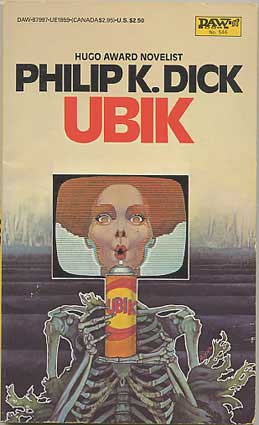
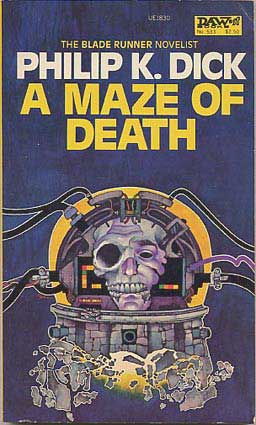
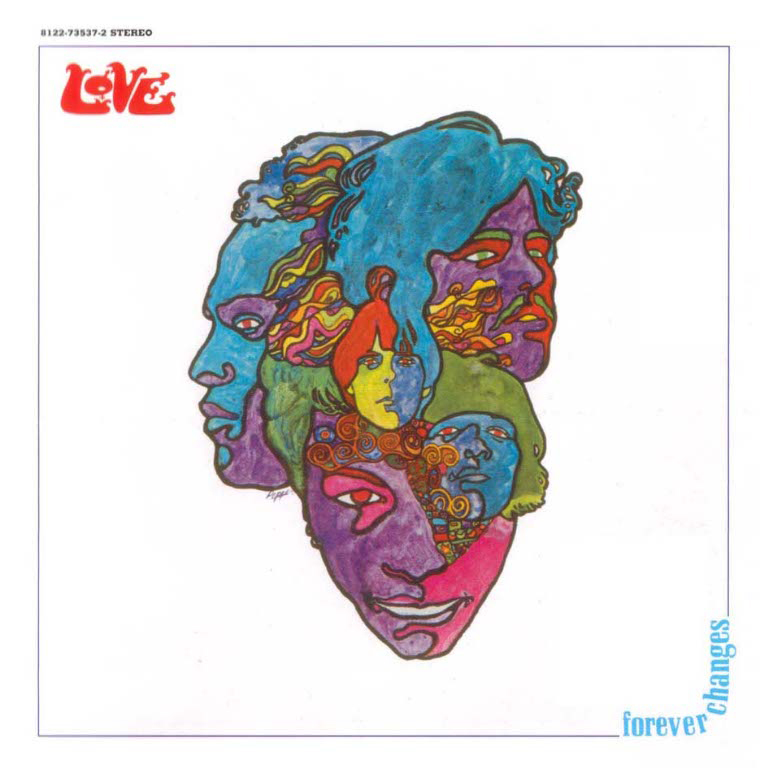
The image was created by Bob Pepper, who did a string of tense, evocative PKD covers for DAW starting in 1982. In an interview, Pepper claims doing six PKD covers, but I only know of four other than Scanner: Ubik, Three Stigmata, Deus Irae, and A Maze of Death, which is the most beautiful besides this one. Pepper started illustrating in the early 1960s, and floated his art on the streams of the counterculture, which was defined as much by the sorts of images it created and consumed as by anything. Pepper’s most famous work in the 60s was the lysergic cover of Love’s album 1967 Forever Changes, a dud at the time but now wisely regarded as one of the most visionary albums of American Psychedelia ever. (As Andrew Hultkrans argues in his great 331/3 book on the album, Arthur Lee’s lyrics are also gnostic as hell.) In the 70s, Pepper did a number of covers for Ballantine’s great and powerfully influential fantasy paperback series, edited by Lin Carter; of special note are his trippy-drippy covers of Mervyn Peake’s Gormenghast Trilogy.

The melty lines and floating eyes of the Scanner image mark Pepper’s art as a product, at least indirectly, of the drug culture, which transformed modern illustration through its embrace of fantasy archetypes, Art Nouveau organicism, and concrete otherwordliness. But by straight-up depicting a moustached stoner smoking weed, Pepper also puts the drugs out in the open. (In a sense, this directness was similar to the move that Richard Linklater made when he cast three notable drug users, Robert Downey Jr., Woody Harrelson, and Winona Rider, in his film adaptation.) For me the frankness of Pepper’s image—at once goofy and kind of disturbing—announces the uncomfortable fact that, whatever else he was, PKD was a druggy writer. He took drugs, he wrote on drugs, he wrote about drugs, and he moved in and out of social scenes where drugs were forms of bonding and pleasure, as well as avenues towards self-destruction, madness, and alienation.

I use the general term “drugs” advisedly. Most of the time it’s a sloppy word with little information content, but in this case, the more specific you get, the more you miss. PKD had his preferences, and was no stoner; as far as I can tell, he experimented little beyond his core love of speed, which helped fuel his writing spells as much as it helped Jack Kerouac or Jean-Paul Sartre. But though it was useful, speed was also a bohemian drug, a reflection of PKD’s long life on the edges of California bohemia. But his personal use isn’t really the point. To use a term created by another guy who spent a lot of time in California, PKD grokked drugs. His fictional concoctions, from Chew-Z to Substance D to all those amphetamine dispensers in Ubik and The Zap Gun, etc, embody and reflect the culture and metaphysics of the drug culture--even if he wasn’t always very happy with their effects on him or his friends.

Erik Davis is the author of Techgnosis, Visionary State, and tons of cool essays. He also was also a consultant on Linklater's adaptation of A Scanner Darkly. You can't front on that.

Henri from The Philip K Dick Bookshelf informed me in a comment Pepper's fifth DAW cover is We Can Build You. Thanks, Henri!

Thursday, March 29, 2012

Total Dick-Head Is Five Years Old Today! (now with links)

You read that right, compadres! TDH is five years old today. In a few more years perhaps the blog will be mature enough to get over the dick jokes, but anyhoo, it's been a fairly unqualified success.

Seriously, the coolest thing about the endeavor was being a part of the PKD scene and meeting so many cool people. Mr Hand over at Philip K Dick and Religion has become a great friend, and Patrick Clark and the Otaku folks are super-cool. Erik Davis and Lord Running Clam... I promised myself I wouldn't cry. It's also nice to see PhilipKDickFans.com up and running again. And Frolix-8 has consistently churned out awesome PKD content for ages. And now we have a festival page. Now we're on Facebook too, please 'like' us so we can look big time. It's nice to see more Dick on the Internet.

It's been a big five years for PKD too:

Published by Library of America
Briefly the subject of two dueling bio-pics
Back-handed compliments by The New Yorker
High Profile Profiles in LA Times, NY Times, Time Magazine, Newsweek...you name it
Cinematic adaptations including Next and Adjustment Bureau
A good adaptation of Radio Free Albemuth and talk of a Gondry-helmed Ubik
Publishing of 975 pages of Exegesis writings
(I was going to link all of these, but you're so good with The Google, you do it)

So it's been a fun time. For some reason I feel like the wave has crested, like the publishing of The Exegesis was Dick's high-water mark in pop-culture - actually I think it was a little before that. Maybe I'm wrong, and when Ubik comes out they'll fire up the Philip K Dick Article Generating Machine and churn out "Troubled Misfit Druggie Wondered What Was Real (And He Predicted Robots!)" articles by the dozen.

So, you probably want some links:

Miguel Conner has posted a cool interview with John Simon, director of Radio Free Albemuth (which we'll all have watched some day) over at Aeon Byte Gnostic Radio. Check it out.

There's short preview trailer that's been released in anticipation of the Full Trailer for the Total Recall remake:


It's got a dodgy chair - generally considered to be the kiss of death in PKD adaptations - those and hats.

Erik Davis, Ted Hand, and I will be presenting at this year's Esotericism Conference in sunny Davis, California on Friday, July 20. You can learn more here.

Forget Paul Giamatti as PKD, reader Mike Winder found this pic to convince all of us in the PKD group on Facebook that Jeff Bridges is PKD:

Wednesday, October 22, 2025

Erik Davis on 'Do Androids Dream of Electric Sheep?'


Big news from The Alembic, where last year Erik Davis gave a multi-week course on The Three Stigmata of Palmer Eldritch. Well, the author of High Weirdness is back, this time offering a five-week course on Dick's most carefully constructed novel: Do Androids Dream of Electric Sheep?

The course is every Monday evening, starting November 3rd. 

Get your tickets here

Sunday, April 14, 2013

Erik Davis Exegizes the Exegesis on Aeon Byte Radio


You read that right, Dick-heads, TDH-pal and annotations editor of The Exegesis of Philip K Dick, Erik Davis, talks up the project with Miguel Connor of Aeon Byte Radio. Check it out here.

btw, my fav review over at amazon - the only one-star review - reads as follows:

"Having nonetities pygmify the Exegesis is not just sacriligeous, it is a clear attempt to censor and sanitise PKD into another crazy visionary pigeonhole, making his commercially lucrative legacy easier to exploit whilst de-emphasizing what was most important to him- namely his VALIS experiences. Not everything can be abridged, least of all by dollar-fixated pygmies and nabob academics."


Saturday, December 29, 2012

Umberto Rossi Reflects on Dortmund PKD Conference (with pics!)

Dear readers, once again I've neglected the blog for too long. But now that the semester's grading is almost complete, and I'm enjoying some time off from work, I have some updates for you. Including a two-post, multi-foci look at the recently completed Dortmund Conference on PKD (well not so recently, last month already). So here's the most prolific Dick scholar on the planet's take on the conference (he takes pictures too! is there anything he can't do?). Take it away, Umberto.


Did I say Rickels? Here he is, ready to deliver his mesmerizing speech about the German integration, helped by uncanny images of Wernher Von Braun. He said he ain't no Dick scholar. C'mon...


Is there anyone who knows more than Mark Bould about sf cinema? I don't think so. He delighted us with his unbelievable Dick-inspired lo-budget movies. Where did he find them? Are they real? Well, that's a question one can never ask at a PKD conference.


Dick in Germany? Why not! It's not just a matter of all those Germans and German artists and psychiatrist and also madmen in his novel... not just a matter of CASTLE and SIMULACRA, you know... Germany is a place with maglev monorails, hi-tech, and a lot of money. And they're ready to use that money for a PKD Conference in Dortmund. Why shouldn't we get there? Why?


And here's the mastermind of the event, Dr Stefan Schlensag... Dickhead extraordinnaire, sf buff (and scholar), graphic novel connoisseur, and he's pal with all those German sf people... (actually there's another mastermind of the event, Walter Gruenzweig, but he is invisible, at least on the web... he's a nice guy nonetheless!)


TU at Dortmund, that is the Technical University. Look what a nice building they have and let us access for our li'l conference... rationalist architecture, but not built in the Twenties... hi-tech, brand new, spic and span... No kipple... no gubble... my, I was impressed.


The stars first! Those who were at SFSU are familiar with Erik Davis, and I don't think I have much to add. We also had some nice breakfast-time talks. Well, he and Laurence Rickels were so patient as to bear with my rambling talks about Italy and other matters.


And then there was Roger Luckhurst, the rising star of UK sf scholarship, who debunked all that psychiatric rigmarole, and when he was over it wasn't a rigmarole anymore. Psychiatry evolves, folks, and it's full of shifting realities. Just like Phil's stuff.


Currywuerst mit pommes-frites... just the right thing to have for lunch in that cold, damp weather... not exactly a wub steak, yet...


And then there was the Italian delegation. Ok, you know this man, a dangerous hoodlum intellectual. Suffice it to say he was there, and his tv program was quite successful--I mean not too unsuccessful. He wasn't assaulted with orange rinds and rotten tomatos.


Wasn't the place gorgeous?


Chris Rudge was in San Fran, and here he is, delivering his intoxicating speech about drugs and PKD... "Methedrine!" he wrote.


From Russia with Love. Uh, not exactly Russia. And yet...


Another big shot of Italian Dickdom... Dr Salvatore Proietti, tenured assistant professor, translator, sf buff, total Dickhead... and a little blurred here, but he had his scramble suit on.


That last, desperate, unyielding, suicidal panel. We were almost done for, but these folks saved the day. I do hope to meet them again in the Orange County Festival, with all you Dickheads. And we'll have the Irvine Integration. No mean feat, believe me.

Stay tuned for Erik Davis's recollections of the event... 


Friday, March 9, 2012

Erik Davis on The Exegesis


Just a quick note today: check out Erik Davis talking bout The Exegesis on Miguel Connor's Aeon Byte Gnostic Radio. Listen here. Good stuff.

Wednesday, November 23, 2011

About Last Night

From the left: Pamela Jackson, Me, Jonathan Lethem (I kinda feel like we're all so famous I shouldn't even have to tell you who's who!)

Well gentle readers, I went and had another magical Dick experience last night (oh, the Google hits I will get for that). Regular reader Ted Hand and I met a few other Dick-heads for dinner before heading to Moe's Books in Berkeley for a big Exegesis event.

It was a pretty big deal with at least 100 people in the store. It was standing room only and I heard they sold something like 80 copies of the book!

Pictured left to right: Erik Davis, Laura Leslie, Pam Jackson, Jonathan Lethem, Isa Dick-Hackett

The guests of honor were: Jonathan Lethem, Pamela Jackson, Erik Davis, and Dick's daughters Laura and Isa. There were people filming there last night and I have their email so I think I'll wait on providing in-depth coverage. Lethem did a great job of explaining the origins and significance of The Exegesis and Pamela Jackson filled us in on the process itself. For me, there wasn't a whole lot of new info. But stay tuned for the video, I figure you'll enjoy it. For now, you can listen to a podcast of the LA Event here.

Incredibly poorly composed picture that does little to convey the size of the crowd. But check out dude's shades.

Afterwords, we went to a smaller party and had a really good time. Like that line from Parsifal, time was turning into space all around us. Lethem had worked at this exact bookstore for years, and now he was returning with success he probably couldn't even imagine back then. I know I have lots of fantasies where I go back to some crummy record store where I used to work, but now I'm rich and powerful. It sure seems like it would feel good, but who knows? And of course we were only a couple blocks from Herb Hollis' record store where Phil used to work and first came into his own.

Anytime you get that many Dick-heads together it's almost like the collective energy somehow substantiates the man. You certainly couldn't look around that room of people and have any doubt that Dick's work has touched people and changed their lives. And when you get us serious folks together, those of us who have dedicated decades to our obsession, it's just really inspiring, almost magical. Our private worlds, the spaces in our minds inhabited by the things we covet, suddenly finding a shared interest, open up in a really beautiful way. I mean, my wife is pretty sick of hearing me talk about Phil Dick, and she hasn't read all the books and doesn't know the mythos. Anyway, my hyperbole is starting to ramble.

What I'm trying to say is that it sure is fun talking to people who find the same value in Dick's life and work. It makes me feel like dedicating two decades to the study of his life was a good thing. And for a while I hadn't really been feeling like that. So, good to know.

Now, quickly on to other topics:

1) We made boingboing!
2) The Guardian reviewed The Exegesis
3) Amazon says The Exegesis is "under review" -- WTF?
4) You can now get the Prophets of SF episode about PKD on Amazon
5) All the cool Dick-heads are tripping on this really amazing PKD interview!

Monday, December 21, 2009

Erik Davis Interviews Jonathan Lethem about Philip Dick


There's a must-read interview of Lethem up over at h+ magazine conducted by none 0ther than TDH friend Erik Davis! It's a meaty interview, knife and fork kind of stuff. Here's a taste:

ED: Dick set many of his tales in what we might now call a “posthuman” future of cognitive-enhancing drugs, psi powers, and other amplifications of human capacity. Many of the developments he envisioned in his own unique way are now edging ever closer to reality, and there are many enthusiasts. While not exactly bleak, Dick had a generally more dark and satiric — and often funny — take on cognitive enhancement. Was he a pessimist or a realist? How would you characterize his particularly lesson about human for today‘s enthusiastic transhumans?

JL: While I‘m hardly an expert on the reality of cognitive enhancement or the transhuman impulse as it‘s working itself out on the contemporary frontier, I suspect Dick had little to offer in the way of a “lesson” for aspirants, except in the senses that were relevant while he was coming of age as a writer — that‘s to say, when the breaking news in the framing of such matters involved names like Freud, Kinsey, Norbert Weiner and, well, A.E. Van Vogt. Dick‘s concerns were ultimately both epistemological and deeply moral — in the sense that a philosopher would use the world moral, not in the sense that, say, Joseph L. Breen would. You know, love, empathy, “what is human?” and so forth. For contemporary voyagers, these matters remain as Dick delineated them: exquisitely local, negotiated on the human-to-human, or human-to-self playing field according to an infinite number of variations and contexts. No sweeping paradigms will do here. We‘re all walking down the street conducting our self-Turing exams every time we pass a homeless person, or greet our spouse at the breakfast table.

Read the rest here.

Friday, August 6, 2010

Stuff I'm Doing, Update

The posts here have been few and far between as I've had quite the summer. I've got a bunch of stuff to post over this coming weekend and then, next Wednesday, I'll be hitting the road with Erik Davis for the two-day drive to the PKD Fest in Blackhawk, Colorado. I'm starting to get really excited. According to organizer Lord RC the Sundance Lodge in Blackhawk will be almost completely full of Dick-heads. Can you imagine?

I'll be giving a couple of talks at the Fest (festival schedule here). On Friday, Erik Davis and I will be speaking about our experience reading The Exegesis. (Oh yeah, I never mentioned I was doing that did I? - That's because I can't talk about it very much, but yes, I am one of the scholars working with Pamela Jackson culling the folders for material to publish in the two expected volumes) On Saturday I'll be giving a talk about the limits of identity in Do Androids Dream of Electric Sheep?. This'll be very much like the lecture I give my students when we talk about the book. Hopefully both of these will be available as a podcast at some point.

Speaking of Do Androids Dream of Electric Sheep?, Cornell is really going all out in promoting the book as the Freshmen novel this year. In fact, the local library is making the book a community read. The big news is that they've contacted your humble blogger and invited me to give a talk. They're even paying the tab! I have to remember not to let all this go to my head, but it's very exciting. There was an article up about the event, but I can't seem to find it now. Hopefully it wasn't all a dream or an implanted memory.

Finally, I just finished writing a new introduction to Anne Dick's memoir, now being reissued by Tachyon Publications, and due out as soon as next month. If I were you I'd be scooping up copies to Anne's self-published edition, seeing as how the first edition, now incredibly rare, commands a pretty penny.

So things are going really well for me. I've decided that the next step is to write a book on PKD. Having now read both Rickels's I Think I Am: Philip K Dick and Eric Carl Link's Understanding Philip K Dick, it's clear to me that we're still missing a detailed, fun to read guide to Dick's life and writing. Rather than wait for someone else to write it, I'm going to try my hand at it. Hopefully the project won't keep me from regularly updating this blog. But, again, this is a great time to contribute guest posts!

Wednesday, January 9, 2013

Erik Davis Recalls Dortmund PKD Conference, Totally


Erik Davis (pictured above amidst the entropy) was nice enough to write a very thorough write up of the recent Dortmund Conference. Actually he wrote it almost two weeks ago, but then my family and I succumbed to the flu and are only now returning to full capacity. In the coming days I'll tell you a bit about my experience reading Nick and the Glimmung to my seven-year-old daughter. Take it away Erik,

This year has held an embarrassment of riches for those of us who like to gather and gab about PKD. The 2012 PKD Festival in San Francisco this last September was a wonderful experience, a rare and perfect blend of scholarship and fandom with lots of talks as well as presentations and even belly dances that broke up the yaddha-ya. And last month, a conglomeration of sharp and generous minds and institutions put together Time Out of Joint: Re-Imagining Philip K. Dick, a conference that, while certainly more academic, was just as friendly, enthusiastic and engaging as the Festival. Held at Dortmund University in Germany, in one of the most modern buildings of this rather ancient institution, the conference featured over three days of non-stop talks, screenings, and performances.

    Though Norman Spinrad was unfortunately held up in Paris with VISA difficulties, the conference hosted a number of ace keynote talks. Umberto Rossi followed up his 2009 article about radio in PKD with a wonderful and funny account of television in Dick's work, a darker but still ambiguous tale of media saturation and the commodification of the imagination. Lawrence Rickels delivered the same dense and cryptic presentation on Germany and the figure of the psychopath as he did at the Festival; hearing it for the second time, I was actually able to follow the whole thing! Roger Luckhurst gave a very insightful and thorough historical account of psychopathology and Philip K. Dick--not just Dick's own fascination with schizophrenia, paranoia, and other disorders, but the constantly changing character of those categories over time. For me, Luckhurst's presentation was one of the most helpful of the whole event, as he illuminated the tendency that many critics have (and that Dick shared himself) to try and diagnose the author. As someone writing about Dick's "nuttier" side, this discussion gave me the helpful perspective that Dick's peculiar mental life conjures up so many possible diagnoses that the effort is frustrated from the get-go. Diagnosis, like everything else in Dick's world, is a moving target, a feedback machine with a life of its own.

    The rest of the conference talks and panels were solid and sometimes excellent, with many younger scholars represented, showing that there is a lively future in store for PKD studies. There was also a wide range of topics addressed--not just the more established discussions of android ethics and other topics in Do Androids Dream of Electric Sheep? (though these were present as well), but also talks on nostalgia, autism, drugs, and the under-appreciated Galactic Pot-Healer, a personal fave that Matt Englund opened up into a discussion of Dick's meta-fictional labyrinth of readers, authors, and texts. As one of the editors of the Exegesis, it pleased me to see how many presenters were using the recently published volume to put forward their (characteristically divergent) takes on PKD, ranging from neurology (Jason Ellis) to religious studies (oh wait, that was me). James Burton had the good graces to deliver a different paper than he did at the Festival, and his analysis of the shift from exegesis to ecology  makes me even more excited about his forthcoming (if ambitiously titled) book, The Philosophy of Science Fiction, which looks at PKD in light of the religious philosophy of Henri Bergson. But Dick himself was not (just) a religious philosopher. Some presenters, including Yari Lanci--who drew attention to some of PKD's neglected 50s work in his discussion of the neoliberalist foreclosure of time--also reminded us of the continued value of more leftist and materialist approaches to Dick.

    Luckily the conference did not drown in academic discourse. In her wonderful Scottish brogue, Fabienne Collingnon presented a cultural history of "cold pac" that was as poetic in its expression as it was intelligent in content. Dutch documentary filmmaker David Kleijwegt showed his new and lovely PKD doc The Owl in Daylight. While most of the faces and concepts will be familiar to Dickheads, Kleiijwegt's editing, soundtrack, and atmospheric, occasionally haunting camera work puts this doc far beyond the usual talking-heads grind, and made me want to see his 2008 film about the indie-rock band Low. The conference also hummed with more fannish enthusiasms as well. One panel devoted to PKD adaptations included co-organizer Stefan Schlensag's passionate dissection of Tony Parker's Androids graphic novel, while Irina Novikova's gave a literally eye-opening overview of PKD translations in Russia (what amazing covers!). One of the conference organizers, Damian Podlesny (a gentle soul from Poland), joined Tommi Brem to discuss a variety of projects, including Brem's ambitious online wiki-index of Dickeana, which readers of this blog will certainly want to check out (http://www.appendix-dick.com/).

    Along with the superb hosting from Walter Grünzweig and his colleagues and students at Dortmund (who kept us rigorously caffeinated and snackified), these presentations--as well as a number of stand-outs I did not mention--makes it a safe bet that a good time was had by all.  The only question on people's minds after the closing talks was not whether there would be another PKD conference in the future, but where and when.

Saturday, April 7, 2007

Where the Magic Happened!


Photo by Michael Rauner

On February 20th 1974, Philip K Dick had the most famous literary hallucination since Allen Ginsberg heard a disembodied William Blake reciting "Ah, Sunflower." The event started simply enough when a prescription painkiller was delivered to Dick's Orange County apartment following some grueling oral surgery. Sutin quotes Dick:

"The doorbell rang and I went out, and there stood this girl with black, black hair and large eyes very lovely and intense; I stood there staring at her, amazed, also confused, thinking I'd never seen such a beautiful girl, and why was she standing there? She handed me a package of medication [Darvon], and I tried to think what to say to her; I noticed, then, a fascinating gold necklace around her neck and I said, "What is that? It certainly is beautiful," just, you see, to find something to say to hold her there. The girl indicated the major figure in it, which was a fish. "This is a sign used by the early Christians."

Dick claimed many things about this encounter, including the contention that a pink beam of light had flashed from the necklace to his third eye at the center of his forehead. The events of that day laid the groundwork for one of Dick's greatest novels, VALIS, as well as a dismal, frenetic, and obsessional search for his own sanity that even by the time of his death eight years later was still largely uncompleted.

Dick-head extraordinaire Erik Davis included the above picture of Dick's 1974 apartment, the very doorstep where Dick stood with the dark-haired girl, in his recent book about California's unique spiritual landscape, Visionary State. Davis writes:

"In February 1974, the sight of a delivery woman's Christian fish necklace triggered a long vacation from reality that included prophetic dreams, intense synchronicities, and reception to hidden messages in Beatles songs. Time went out of joint, and once Dick saw the architecture of Rome settle over Orange County. His spirit ranged across the map, but his most consistent themes were Gnostic and Christian, and he often felt himself to be in telepathic contact with a secret follower of the early church."

In a short email interview Davis responded to a couple Dick-head questions:

TDH: How did you locate the 2.3.74 apartment?
ED: I did a web search and discovered letters he had written that featured the addresses. Actually there were two apartments about half a block apart in Fullerton: he moved sometime either in late 73 or early 74. Initially the photographer Michael Rauner shot the earlier apartment, thinking it was the 2/3/74 place. Later a hunch led me to double-check, and so we shot the real apartment where he met the delivery woman--I am glad I got it right, but Michael was bummed because the first shot was tons better!

TDH: What kind of a vibe did the place have? How did you feel standing in that doorway?
ED: Like I was checking out a cruddy early 70s SoCal apartment building. Nothing special--which to my mind is what makes them special. My book was about "sacred sites," and as a Californian Dick-head, for me the site of 2/3/74 is a kind of sacred site. But what makes it sacred is precisely the mixture with the profane, with the ordinary tacky cruddiness of the SoCal suburban landscape.

TDH: What five novels of PKD would you recommend off the top of your head?
ED: The Three Stigmata of Palmer Eldritch
Ubik
VALIS
A Maze of Death (the odd choice, I know, but to my mind it is the most underrated of his novels)
A Scanner Darkly

Update: Reader Scott directs us to R. Crumb's rendering of the fateful drug delivery.

Friday, May 11, 2007

Posthumous Interviews and Stage Appearances


In the spirit of recent posts examining Dick's posthumous appearances in other author's fiction, I did some research into posthumous interviews with PKD. One of my favorites was written by Dick-head extraordinaire (and author of Techgnosis) Erik Davis who explains the circumstances of his interdimensional dialog:

"I was recording the analog noise between tracks on a scratchy old copy of Karl Muck conducting Parzifal with the Bayreuth Festival Chorus onto a cassette tape. Then I would cut, splice, and process the tape in various ways, and then listen to the results. On the third attempt I heard a voice that I recognized, from a tape once available through the Philip K. Dick Society, as belonging to the late science fiction writer. More incredible was my discovery that, by recording my own questions on the same cassette tape, I was able to initiate a genuine dialogue with this mysterious voice. Subsequent research proved, however, that all of the quotations have already made an appearance somewhere in Dick's fiction, letters, or essays. Nonetheless, the conversation seems worth presenting:

ED: How exactly would you characterize [your] novels?

PKD: My writing deals with hallucinated worlds, intoxicating and deluding drugs, and psychosis. But my writing acts as an antidote, a detoxifying, not intoxicating, antidote.

ED: After years of neglect, most of your books are back in print. Even so, you remain best known as the guy who wrote the book they based Blade Runner on.

PKD: I've been calling it "Road Runner."

ED: Heh. What did you think when you first saw that rainy, claustrophobic cityscape?

PKD: I thought, by God, these guys have figured out what life is going to be like forty years from now. My God! It's like everything you hate about urban life now, escalated to the level of Dante's Inferno. You can't even run in the future, there's so many people milling around, doing nothing.

ED: Today it seems as if your work will live on through the movies. How was your own experience working with Hollywood?

PKD: They buy and sell human beings. It's like it says in the Bible about Babylon, they sell pearl, ivory, and the souls of men. And that is exactly what it going on in Hollywood, they deal with the souls of human beings."
Read the rest...
Philip K Dick can be charming from beyond the grave by proxy!
But he's not just doing interviews; he's done some off, off Broadway dinner theatre. Over at The Philip K Dick Bookshelf I spied this small press publication:
Kindred Blood in Kensington Gore
Philip K Dick in the Afterlife: An imaginary conversation
By Brian W Aldiss

It's described over at Philipkdickfans.com as:
"...24 pages long, and consists of a 5000 word playlet involving just two characters - the spirit of Philip K Dick (ten years after his death, now resident in London near the Albert memorial), and a woman variously identified as his twin sister Jane, his father Edgar, and VALIS. The play was first performed in October 1991, with Petronilla Whitfield as the woman and Aldiss himself playing the part of Dick. I saw a subsequent performance (with the same actors) at the Institute for Contemporary Arts in London in March 1992."

PKD is even reanimated in silly little movie reviews like this one for 'Next':
"[Dick] might have been the man to sit Nicolas Cage down - probably with a largish bottle and a coffee table covered in expensive, paranoia-inducing pharmacological treats - and demand to know if Cage honestly expected the second half of his career to unfold with the same lazy, by-the-numbers ease as the first half. He might have asked Cage if he really thought the powers that be would let him get away with another two decades of intermittent decent performances like, say, Leaving Las Vegas, surrounded by heavy servings of the same old action-hero crap like he's been doling out recently."

So let's recap. When PKD isn't manifesting himself on magnetic tapes, he's onstage speaking with an English accent of unknown origin, or sitting Nic Cage down to jump start the aging actor's mid-life crisis over pharmaceuticals. Busy man.

And the location of Android-Dick's missing head remains unknown....

Tuesday, January 1, 2013

Now Read About Last Year, Then Purchase and Read My Fiction!

 
Happy New Year, gentle readers! 2012 was quite a ride for this humble blogger. Philip K Dick Festival, done and accomplished, a roaring success -- a success which still nourishes me during this cold and dark winter. Such memories: I gave Jonathan Lethem a ride in my car. Umberto Rossi and Laurence Rickels rode in that car too! Watching Radio Free Albemuth with 120 Dick-heads! These aren't sentences, mostly because no mere arrangement of words can capture how great it was.

Was there any other Dick news in 2012? Lawsuits, adaptations and rumors of adaptations, down websites, the rise of the Facebook PKD group, Precious Artifacts!, two issues of PKD Otaku!.

Pretty good year. 

Now, what do we have to look forward to in 2013? Well it's the year when Linklater's version of A Scanner Darkly is set. Will a quarter of the population get hooked on Substance D (otherwise known as Fox News)? Perhaps. Will we see a theatrical release or Netflix appearance of Radio Free Albemuth? Stay tuned to find out.


2013 is starting out on a high note for me personally, with not one, but two science fiction stories out today. My story "Escape Velocity" is in issue six of Speculative Edge which is available in both Kindle and print editions.


And I've got another story, "Bedroom Eyes" appearing in issue one of Theurgy Magazine. That one you can read online (here), and if you like it, you should probably order a hard copy (here). The cool thing is my co-editor at Pravic, Nathaniel K Miller also got a story placed in Theurgy, so they've obviously have good taste. Speaking of which, you have issue one of Pravic, right? Well stay tuned, issue number two is imminent.

In terms of Dick stuff, I've got Erik Davis' write up from Dortmund to run in the next couple days. Radio Free Albemuth at the Philip K Dick Film Festival! Reading Nick and the Glimmung with my seven-year-old. Sentence fragments, again! Time to go.

Saturday, June 28, 2008

Old Vertex Magazine PKD Interview and Photos

Dick-head extraordinaire Erik Davis recently sent me some scans of a long interview Vertex magazine did with Philip K Dick. I have no idea what year this came out, but I'm guessing 1980 0r 81 (Henri at The Philip K Dick Bookshelf dates the issue from February 1974 - a big month for PKD). The interview is fantastic, one of the best I've read, exploring Dick's craft, his opinions on contemporary science fiction, LSD, the I Ching, and his characters. And the pictures, well they're worth the price of admission. Click images to enlarge.


Saturday, June 8, 2024

Get to Know the Fest Guest: Part 5 -- Gabriel Mckee


We're less than a week away from Dick-Fest 2024. In fact, you'll find some pretty detailed info and a schedule here, which is otherwise dedicated to our series dedicated to getting to know the presenters at this year's Fest. So, without further ado, is my interview with Gabriel Mckee: 

What are you gonna talk about at the fest?

 I'll be talking about ideas of control and freedom in the Exegesis, particularly as they relate to the concept of "astral determinism" in Hellenistic religion and philosophy-- the idea that human destiny is controlled by external forces (in particular, the stars and planets). The starting point of my talk is sections of the Exegesis where Phil is talking about the dreaded "Xerox missive," which took on a central importance in his understanding of what liberation meant. The idea of breaking free from the path that the universe has prepared for you-- metaphorized as "groove override" in the universe's eternal LP-- is an absolutely crucial one in the Exegesis, and the concrete example Phil is talking about is his reaction to the weird photocopy he got in the mail. After a career of writing about androids who think they're human, Phil found himself mired in anxiety over the idea that he was subject to some kind of external control-- but that he had pushed through and found himself experiencing a sense of freedom when he didn't look at the letter, didn't do whatever destructive thing it was that it was intended to bring about. I don't think it really matters what the true origin or content of the letter was; it's mainly important for having become a symbol through which Phil explored themes of fate/destiny/programming and freedom/choice/liberation.  I look at this through the lens of modern ideas--particularly Jay Kinney's concept of "agency panic"-- and ancient ones-- early Christian and Hellenistic texts about astrological control.

How’d you get involved in Dickdom? 

PKD was one of the first SF authors I read when I started getting into the genre toward the end of high school. A friend lent me a copy of VALIS and I was instantly obsessed. It got me interested not just in science fiction, but in religion and theology as well. I was active on the old Jazzflavor email list and ended up studying religion as an undergraduate and going on to a master's from Harvard Divinity School-- along the way writing Pink Beams of Light From the God in the Gutter: The Science-Fictional Religion of Philip K. Dick (University Press of America, 2004), and the PKD-adjacent The Gospel According to Science Fiction (Westminster John Knox, 2007) shortly thereafter. When I heard that Jonathan Lethem and Pamela Jackson were working on an edited version of the Exegesis back in 2010, I knew I had to be involved-- and am grateful to Erik Davis and Rich Doyle for helping to facilitate that. 


What kind of Dick-related work are you currently involved in? 

I've just finished a major non-PKD project that I have been working on for several years: The Saucerian: The Unbelievable Life of Gray Barker, a biography of a prolific UFO book author, publisher, and showman, which is due out early next year from MIT Press. I'm contributing smaller pieces to a couple other PKD projects, including George Sieg & Michael Barros's edited volume The Esoteric Theology of Philip K. Dick (forthcoming from Lexington Books) and Keith Giles and David Agranoff's Dickapedia. I've also been an active collaborator in the Zebrapedia project since its inception, and have been talking to Rich Doyle about ways to enhance the online Exegesis interface-- I hope to have some more news to share at the Fest about coming developments there.